

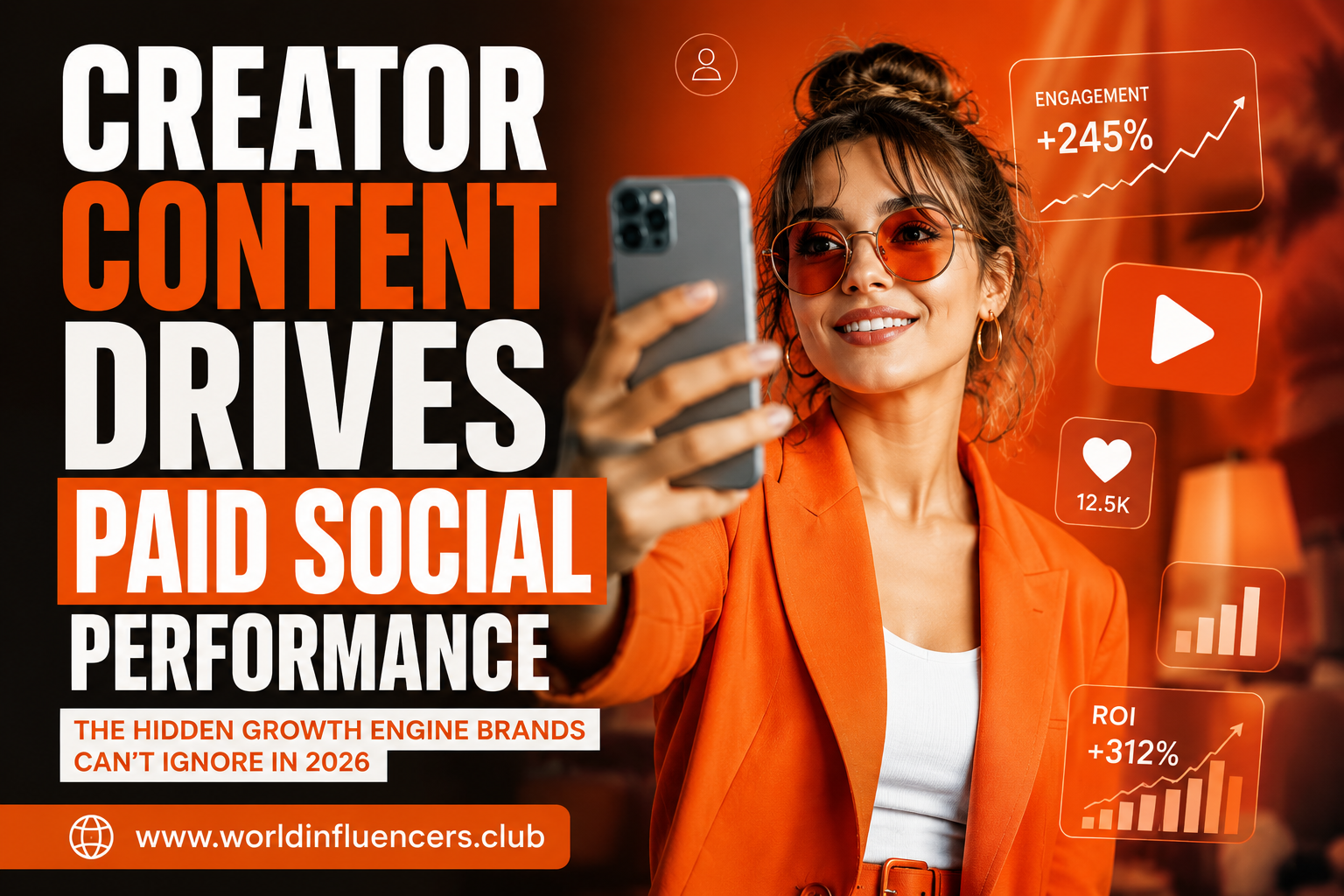
Why Creator Content Now Drives Paid Social Performance
In today’s digital advertising ecosystem, one shift is quietly redefining how brands grow, scale, and convert audiences into loyal customers. That shift is creator content becoming the central driver of paid social performance.
What was once treated as an “add-on” for brand awareness has now evolved into a performance-critical asset. In fact, creator-led content is no longer just influencing engagement metrics—it is directly impacting return on ad spend, conversion rates, and customer acquisition costs across platforms like Meta, TikTok, YouTube Shorts, and Instagram Reels.
The question is no longer whether creator content works. The real question is why it outperforms traditional branded advertising so consistently, and why brands that ignore it are quietly falling behind.
The Collapse of Traditional Ad Trust
Over the last few years, audiences have become increasingly resistant to polished, corporate-style advertisements. Users scroll past overly produced ads in seconds. The brain has been trained to filter them out.
This is where creator content wins.
Creators speak in a human voice, not a marketing script. Their content feels native to the platform, not inserted into it. This subtle difference dramatically increases attention retention and emotional connection.
When a user sees a real person demonstrating a product, sharing a story, or reacting authentically, the brain processes it as peer-to-peer communication rather than advertising. That psychological shift is what drives higher engagement and better conversion performance in paid social campaigns.
Why Platforms Are Rewarding Creator-Led Ads
Social media algorithms have evolved. Platforms are now optimized for content that keeps users engaged longer, not just content that looks professional.
Creator content naturally performs better because it:
- Blends into organic feeds
- Encourages comments and shares
- Increases watch time
- Feels authentic and relatable
As a result, platforms are indirectly lowering costs for creator-led ads. Brands using creator content often see lower CPMs and higher click-through rates compared to traditional brand creative.
In simple terms, platforms are rewarding authenticity because authenticity keeps users on the platform longer.
The Psychology Behind Higher Conversions
At the core of creator content performance is trust psychology.
Consumers do not buy products based on features alone. They buy based on belief, validation, and emotional reassurance. Creator content delivers all three.
When a creator demonstrates a product in a real-life scenario, it removes friction from the decision-making process. Instead of asking “Does this work?” the audience starts thinking “This works for people like me.”
That shift from skepticism to identification is what drives conversion efficiency in paid social campaigns.
Paid Social Has Become a Creative Distribution Engine
In the past, paid social was primarily about targeting and budgeting. Today, it is about creative performance.
The best targeting strategy in the world cannot fix weak creative. But strong creator content can outperform even average targeting.
Modern paid social success depends on:
- Hook strength in the first 3 seconds
- Relatable storytelling
- Native platform behavior
- Emotional resonance
Creator content naturally aligns with all of these elements, making it the most scalable performance asset in digital advertising today.
The Rise of “UGC-Style Performance Ads”
User-generated content style ads have become one of the most powerful formats in performance marketing.
These are not random influencer posts. They are structured, performance-driven creatives designed to look organic while being strategically engineered for conversion.
Brands are increasingly building entire ad libraries composed of:
- Product demo videos from creators
- Before-and-after storytelling
- Problem-solution narratives
- Reaction-based testimonials
This format reduces skepticism and increases perceived authenticity, which directly improves conversion rates.
Why Brands That Ignore Creator Content Are Losing Efficiency
The gap between creator-led campaigns and traditional branded ads is widening.
Brands relying solely on polished studio ads often face:
- Higher cost per acquisition
- Lower engagement rates
- Fatigue from repetitive creatives
- Declining click-through performance
Meanwhile, brands integrating creator content into their paid social strategy are seeing:
- Faster testing cycles
- More scalable ad variations
- Lower production costs
- Higher ad longevity
The performance gap is no longer marginal. It is structural.
The New Creative Strategy Framework
Winning in paid social today requires a shift in thinking. Instead of asking “What should our ad look like?”, brands must ask “How would a real person talk about this?”
The most effective framework now includes:
- Hook: A relatable problem or emotional trigger
- Story: A real-life usage scenario
- Proof: Demonstration or transformation
- Outcome: Clear benefit or result
This structure mirrors natural human storytelling, which is why it performs better across platforms.
The Future of Paid Social Belongs to Creators
We are entering a phase where creators are no longer just collaborators. They are becoming the primary media channel for brands.
Instead of brands pushing ads, creators are pulling attention. Instead of polished campaigns, we are seeing narrative-driven content ecosystems.
The brands that will dominate the next wave of digital growth are not necessarily the ones with the biggest budgets, but the ones with the strongest creator ecosystems.
Conclusion: Attention Has Shifted, and So Must Strategy
Paid social performance is no longer driven by who spends the most, but by who communicates the most authentically.
Creator content has become the bridge between attention and conversion. It builds trust faster, communicates value more naturally, and performs more efficiently in algorithm-driven environments.
Ignoring this shift is no longer a creative choice. It is a strategic risk.
The future of paid social performance is not polished. It is personal.