

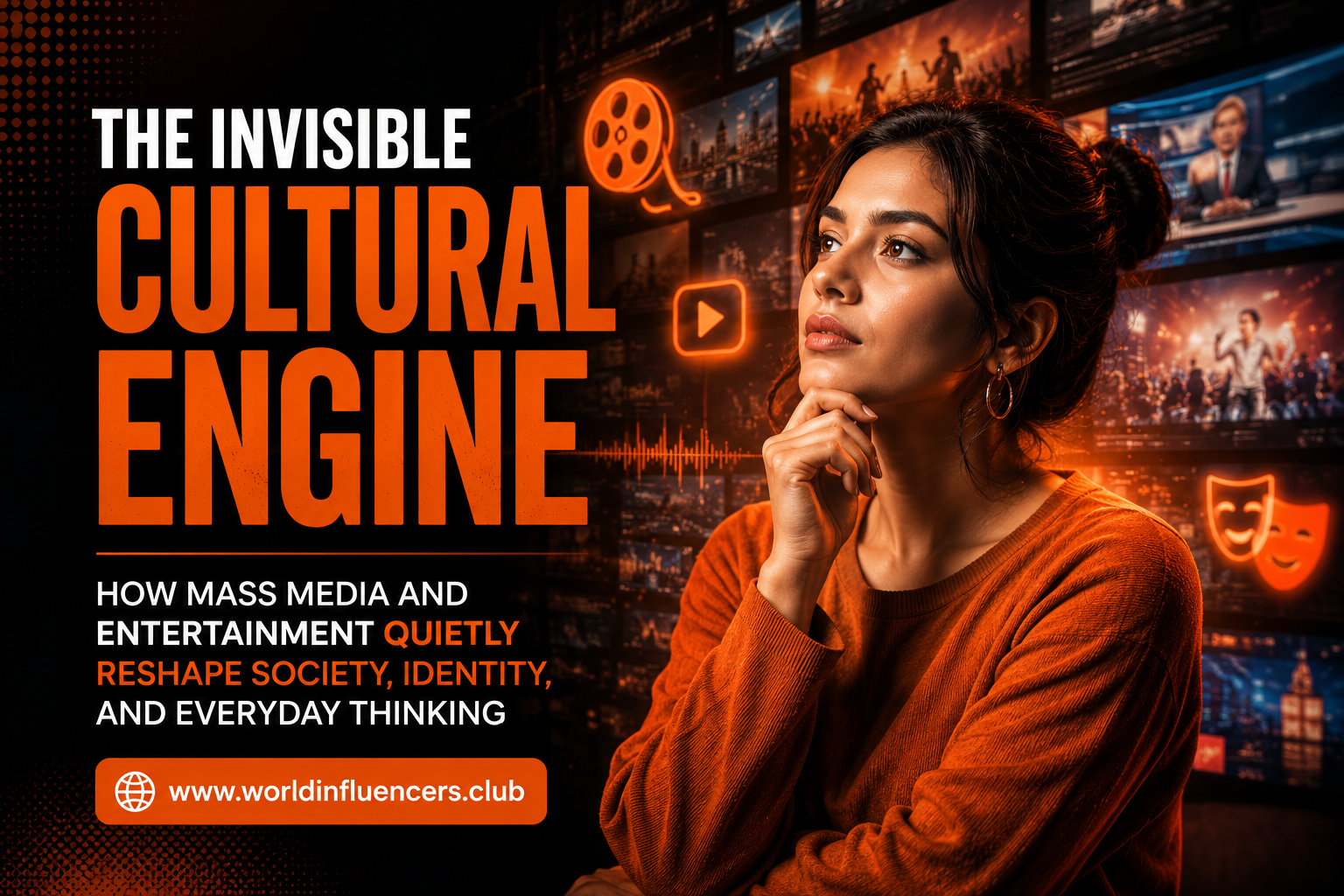
Mass media and entertainment are no longer just sources of information or leisure. They have become powerful cultural architects, quietly shaping how people think, what they value, how they behave, and even how they define themselves.
From television and films to social media platforms, streaming services, music, and influencer culture, the modern world is being continuously rewritten in real time. Culture is no longer inherited slowly across generations; it is being updated instantly, shaped by algorithms, headlines, viral content, and entertainment narratives.
What makes this influence so powerful is that it does not feel like influence. It feels like choice.
And that is exactly why it matters.
The silent shift from information to influence
Mass media once primarily served as a source of news and storytelling. Today, it functions as a behavioral system. It does not only tell you what is happening; it subtly suggests how you should feel about it.
Entertainment amplifies this effect. Films, series, and online content do not just reflect society; they construct versions of it. Over time, repeated exposure to certain narratives begins to normalize them.
When people consume similar content daily, across platforms, the boundaries between reality and representation begin to blur.
This is where cultural influence becomes structural rather than superficial.
How entertainment rewires perception and identity
Entertainment is one of the strongest forces in identity formation, especially in younger generations. Characters, celebrities, influencers, and digital personalities become reference points for behavior, lifestyle, and aspiration.
People begin to model:
- How they speak
- How they dress
- What success looks like
- What relationships should feel like
- What lifestyles are desirable or acceptable
This is not accidental. Media ecosystems are designed to maximize engagement, and emotional content performs best. As a result, culture becomes increasingly emotional, dramatic, and trend-driven.
Over time, identity becomes less about lived experience and more about curated exposure.
The algorithmic culture machine
Modern mass media is no longer fully human-curated. Algorithms decide what content is visible, recommended, and amplified.
This creates a feedback loop:
- Users engage with content
- Algorithms learn preferences
- Similar content is pushed more aggressively
- Exposure shapes beliefs and behavior
- Engagement increases further
This loop means culture is no longer just created by artists, journalists, or filmmakers. It is co-created by data systems optimizing attention.
What spreads is not always what is most meaningful, but what is most engaging.
The normalization effect: how repetition becomes reality
One of the most powerful impacts of media is normalization.
When ideas, behaviors, or lifestyles are repeatedly shown in entertainment and news, they begin to feel normal, even if they were once uncommon or controversial.
This includes:
- Social values
- Fashion and lifestyle standards
- Relationship expectations
- Consumer behavior
- Political and cultural perspectives
Over time, repetition creates familiarity. Familiarity creates acceptance. Acceptance becomes culture.
Consumer culture and the attention economy
Mass media and entertainment are deeply tied to consumption. Every platform competes not only for attention but for influence over spending behavior.
Entertainment content often shapes desire before awareness:
- What people want to buy
- What brands they trust
- What lifestyles they aspire to
- What success looks like materially
This creates a culture where identity and consumption are closely linked. People are not just watching content; they are being positioned as consumers within that content.
The emotional engineering of modern media
Emotion is the currency of mass media.
Content that triggers strong emotional reactions spreads faster, whether it is joy, outrage, inspiration, fear, or curiosity.
This leads to:
- Shortened attention spans
- Heightened emotional sensitivity
- Rapid opinion shifts
- Increased polarization in some contexts
Entertainment and news increasingly rely on emotional framing to remain competitive in crowded attention spaces.
As a result, emotional intensity often outweighs informational depth.
Cultural acceleration and identity fragmentation
One of the most significant effects of modern media is acceleration. Trends that once took decades to spread now go viral in hours.
This creates a fast-moving cultural environment where identities are constantly updated.
However, it also leads to fragmentation:
- Multiple subcultures exist simultaneously
- People consume entirely different realities
- Shared cultural references are shrinking
- Global and local identities overlap and clash
Culture becomes less unified and more modular, shaped by personalized media feeds.
Why this matters now more than ever
Understanding media influence is no longer optional. It directly impacts:
- How societies make decisions
- How individuals form beliefs
- How economies evolve
- How political and social movements grow
In many ways, mass media is now a primary environment in which modern human consciousness operates.
Not recognizing this influence means being shaped by it unconsciously.
Recognizing it creates the possibility of choice.
Conclusion: culture is no longer passive, it is engineered
Mass media and entertainment are not just reflecting culture; they are actively constructing it.
Every piece of content contributes to shaping perception, behavior, and identity. The result is a world where influence is continuous, subtle, and deeply embedded in everyday life.
The most important question is no longer what media you consume, but what that media is slowly turning you into over time.